How Environmental Stressors Make Your Skin Age Faster — And What to Actually Do About It
You cleanse. You moisturize. You use good products every day — and still notice dullness, fine lines, or an uneven tone that doesn’t seem to budge. Here’s what’s likely going on underneath the surface, and it has more to do with your environment than your routine.
There’s a reason two women can follow nearly identical skincare routines and end up with completely different skin over time. One of the biggest variables is invisible: the environmental load your skin deals with every single day. Sun, pollution, dry air, smoke, temperature swings, and even the quality of air inside your home all weaken skin in ways that compound quietly — and often get blamed on aging or genetics instead.
The good news? You don’t need an entirely new routine to address this. You need to understand what’s actually happening beneath the surface — so you can make a few targeted, evidence-backed changes that genuinely add up.
What Environmental Stress Actually Does to Your Skin Over Time
Skin ages for many reasons: time, hormones, genetics. But repeated exposure to harsh environments accelerates the visible part of that process in ways that have nothing to do with how old you actually are.
When skin faces daily environmental stress, two things happen simultaneously. First, it loses water faster because the skin barrier becomes compromised. Second, it repairs itself more slowly because the repair process is constantly interrupted by new damage. Over time, this degrades the structural proteins that keep skin smooth, firm, and even-toned.
Collagen and elastin — the proteins responsible for skin firmness and elasticity — are broken down by enzymes called matrix metalloproteinases (MMPs), which are directly triggered by UV exposure and oxidative stress. Research published in the Journal of Investigative Dermatology shows that UV radiation activates MMPs within minutes of exposure, leading to measurable collagen degradation. With repeated daily exposure, this damage accumulates faster than the skin can repair it — producing the visible thinning, roughness, and loss of elasticity associated with premature aging.
Chung JH, et al. Modulation of skin collagen metabolism in aged and photoaged human skin in vivo. J Invest Dermatol. 2001;117(5):1218–1224.One of the first signs of environmental skin stress isn’t always a wrinkle. It’s that flat, tired look that doesn’t improve much even after a full night’s sleep — or a complexion that looks dull in a way that serums don’t seem to fix. If that sounds familiar, environmental load may be playing a bigger role than your products.
The Three Mechanisms That Speed Up Aging
1. Free Radicals and Oxidative Stress
Free radicals are unstable molecules that damage healthy skin cells by stealing electrons from surrounding molecules — including collagen and elastin fibers. Your skin generates some naturally, but UV light, air pollution, and cigarette smoke dramatically increase free radical production. When this excess overwhelms your skin’s natural antioxidant defenses, the result is oxidative stress — one of the primary mechanisms of premature skin aging.
Seminal work by Pinnell (2003) in the Journal of the American Academy of Dermatology established that UV-induced free radicals cause DNA damage in skin cells within seconds of sun exposure. Topical antioxidants — particularly vitamin C — can help neutralize this damage before it accumulates, but the skin’s endogenous antioxidant capacity is finite and becomes depleted under sustained environmental load.
Pinnell SR. Cutaneous photodamage, oxidative stress, and topical antioxidant protection. J Am Acad Dermatol. 2003;48(1):1-19.2. Chronic Low-Grade Inflammation
A small amount of inflammation is part of healthy skin repair. The problem arises when environmental triggers — pollution particles, UV radiation, harsh cleansers — keep inflammation running at a low level constantly. Researchers now call this pattern “inflammaging”: inflammation-driven aging. This sustained irritation interferes with collagen production and repair processes, making skin more reactive and less resilient over time.
3. A Compromised Skin Barrier
Your skin barrier is the outermost layer that holds moisture in and keeps irritants out. When it’s healthy, skin stays hydrated, calm, and resilient. When it’s weakened — by harsh cleansers, over-exfoliation, dry air, or daily pollution exposure — moisture escapes faster and irritants penetrate more easily, keeping skin in a state of low-level reactive stress.
These three mechanisms don’t work in isolation. They amplify each other: oxidative stress weakens the barrier, a weakened barrier allows more irritants in, and those irritants drive more inflammation and free radical production. It’s a cycle — and it’s why stressed skin can visibly look older than it biologically is.
The Biggest Environmental Culprits — Ranked
Sun Exposure: The #1 Driver of Premature Visible Aging
This one is not close. Dermatologists estimate that roughly 80–90% of visible skin aging — wrinkles, dark spots, sagging, rough texture — is caused by cumulative UV exposure rather than the passage of time itself. This specific type of damage even has its own name: photoaging.
A landmark study published in Plastic and Reconstructive Surgery examined identical twins — who share the same genetics — and found that lifetime sun exposure was the single strongest predictor of differences in visible aging between them. Twins with greater UV exposure consistently showed deeper wrinkles, more sagging, and more uneven pigmentation than their identical counterparts. Because genetics were controlled for entirely, the study isolated UV as the primary variable.
Guyuron B, et al. Factors contributing to the facial aging of identical twins. Plast Reconstr Surg. 2009;123(4):1321–1331.UVA rays (the aging rays) penetrate deep into the dermis and pass through cloud cover and window glass. UVB rays (the burning rays) act at the surface. Both cause cumulative damage. Driving, sitting near a bright window, walking to your car — all of it adds up quietly over years in ways that are very visible in retrospect.
Air Pollution and Smoke: The Daily Load You Can’t See
Air pollution doesn’t just pass by — it settles on the skin’s surface and can work its way into pores, where it triggers oxidative stress and inflammation. Traffic exhaust, industrial fumes, wildfire smoke, and cigarette smoke all contain fine particulate matter and reactive compounds that accelerate skin damage independently of UV exposure.
A large-scale epidemiological study of women in Germany and China, published in the Journal of Investigative Dermatology, found that chronic exposure to traffic-related air pollution was significantly associated with increased pigment spots and accelerated facial aging — independent of UV exposure and lifestyle factors. Fine particulate matter (PM2.5) was the primary driver.
Vierkötter A, et al. Airborne particle exposure and extrinsic skin aging. J Invest Dermatol. 2010;130(12):2719–2726.For many women, the first visible sign isn’t wrinkles — it’s a duller, more uneven tone, or post-breakout marks that take longer than expected to fade. Pollution exposure worsens both of these. If your skin feels grimy by the end of a city day even without wearing makeup, your skin barrier is responding to what it’s been exposed to.
Weather, Indoor Air, and the Daily Habits That Quietly Deplete Your Skin
Cold wind strips moisture from the skin’s surface faster than almost any cleanser can. Low indoor humidity — particularly in heated or air-conditioned spaces — pulls water from skin all day long, even when you’re sitting still. Hot showers, though they feel restorative, disrupt the lipid layer of the skin barrier and increase trans-epidermal water loss for hours afterward.
Stress and poor sleep compound all of this. Cortisol — your primary stress hormone — increases oil production, slows collagen synthesis, and measurably impairs skin’s repair cycle. And sleep deprivation is not a cosmetic problem: research published in Clinical and Experimental Dermatology found that consistently poor sleepers showed lower skin elasticity, greater water loss, and slower recovery from UV exposure than good sleepers, even controlling for other variables.
Human growth hormone — which drives cellular repair and collagen synthesis — peaks during the first few hours of deep sleep. Studies consistently find that sleep deprivation reduces skin barrier recovery, increases inflammatory markers, and slows healing time. No topical product currently demonstrated in clinical trials compensates for the effects of chronic sleep restriction on skin health.
Oyetakin-White P, et al. Does poor sleep quality affect skin ageing? Clin Exp Dermatol. 2015;40(1):17–22.How to Protect Your Skin From Environmental Aging — Practically
You cannot eliminate every environmental trigger. The goal is to meaningfully reduce your skin’s daily load — and give it the tools to recover when that load is unavoidable. A streamlined routine done consistently will outperform an elaborate one done occasionally, every single time.
Build a Routine That Defends and Repairs
Small Lifestyle Habits That Compound Over Time
The routine matters. So does the 23 hours a day when you’re not actively doing skincare.
A wide-brimmed hat and UV-protective sunglasses reduce your face’s UV load more effectively than reapplying SPF alone — and they protect the eye area, where skin is thinnest and UV-related thinning and lines appear earliest.
A bedroom humidifier during dry months or in air-conditioned spaces meaningfully reduces overnight trans-epidermal water loss. Studies show that ambient humidity below 40% measurably increases skin dryness and barrier disruption even without any other stressors present.
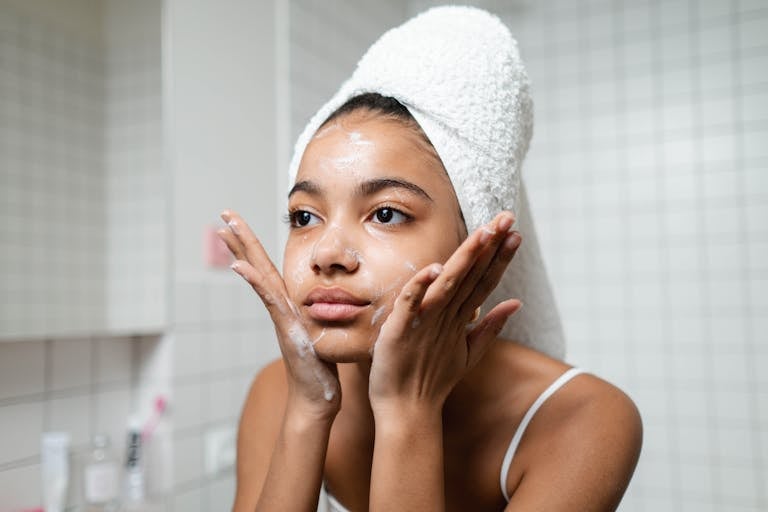
A gentle rinse after heavy sun or pollution exposure removes particulate matter and oxidized oils before they have time to penetrate pores or trigger further inflammation. This is especially valuable after long outdoor days or time in heavy traffic.
Water temperature during cleansing matters more than most people realize. Hot water dissolves the natural oils in the skin barrier. Lukewarm is genuinely enough, and the difference in barrier integrity over weeks is measurable.
Sleep is not passive skincare. Collagen synthesis and cellular repair peak during deep sleep stages. Consistently short or disrupted sleep isn’t just a lifestyle issue — it’s a skin issue with documented, measurable effects. No serum compensates for it.
→A Note on Realistic Timelines
Environmental skin damage is cumulative. It built up over years, and it reverses gradually — not overnight. A consistent, protective routine used over months produces real, visible results. A two-week experiment won’t, and expecting it to is one of the most common reasons women cycle through products without ever seeing genuine change.
The research on daily SPF use, topical antioxidants, and barrier repair ingredients consistently shows measurable improvements in skin quality over 12–16 weeks of consistent use. The skin you’ll have in ten years is being determined, in meaningful part, by what you do consistently right now.
Environmental stressors — UV radiation, air pollution, dry air, daily lifestyle habits — are a major and often underappreciated driver of premature visible skin aging. The mechanisms are well-documented: free radical damage, chronic low-grade inflammation, and a compromised barrier all compound each other in a cycle that accelerates what time alone would do much more slowly.
But the counter-strategy doesn’t need to be complicated. Daily broad-spectrum SPF, a gentle cleanser, a barrier-supportive moisturizer, and one well-chosen antioxidant or evening active can do most of the work. The rest comes from consistency, sleep, and a few protective habits that work on the other 23 hours of your day.
Small things, done reliably, build the skin you’ll have for the rest of your life. That’s not marketing copy — it’s what the research actually shows.