The Volume Killers: 5 Ingredients Hiding in Your Shampoo That Are Weighing Your Fine Hair Down
If your hair is flat by 2 PM, no matter what products you try, your shampoo may be the problem — not your hair. Here’s how to catch the hidden ingredients working against you, and what to do next.
You’ve tried the volumizing shampoo. You’ve tried the root-lifting spray. You’ve tried washing every day, then stretching it to every other day. Nothing works. By midmorning, your hair is lying flat against your head like it gave up, and by afternoon, it looks like you haven’t washed it in a week.
Here’s something most fine-haired people never find out: the problem often isn’t their hair at all. It’s a handful of specific ingredients — common, legal, and found in dozens of expensive “volumizing” products — that coat the hair shaft, suffocate fine strands, and build up invisibly over weeks of washing. The beauty industry calls these products “nourishing.” Your fine hair calls them a weight problem.
This post gives you the exact ingredient list to look for, explains why each one is so damaging to fine hair specifically, and tells you how to read any label in under ten seconds. Consider this the fine-hair education that no one gave you when you were standing in the drugstore aisle feeling lost.
“Fine hair isn’t hard to manage — it’s just easily weighed down. Most ‘volume’ products contain the very ingredients that flatten fine hair over time.”
Affiliate Disclosure: This page contains affiliate links. If you purchase through my links, I may earn a small commission at no extra cost to you. I only share products I believe align with my brand and support my readers’ needs.
Why Fine Hair Gets Weighed Down So Easily
Fine hair strands have a smaller circumference than average or coarse hair. That sounds like a simple fact, but it has a significant consequence: any coating that sits on the outside of the strand affects fine hair dramatically more than it affects thicker hair.
Think of it like painting a pencil versus painting a fence post. The same coat of paint looks thin and barely visible on a thick post. On a pencil, it doubles the diameter. Silicones, heavy butters, and petroleum-derived waxes do the same thing to fine hair — they add a physical, invisible coating that makes each strand heavier, limper, and slower to respond to styling.
The crueler twist is that these ingredients are everywhere. They’re in moisturizing shampoos, “repairing” conditioners, anti-frizz serums, and yes, products marketed specifically for “volume.” The front label says what you want to hear. The ingredient list tells the truth.
The Core Problem
Most people with fine hair blame their scalp for getting oily too fast, or their hair for being “fine” — when in reality the buildup from silicones and heavy emollients is forcing them to wash more often, which dries out the scalp, which produces more oil, which demands more washing. It’s a cycle that starts with the wrong ingredient list.
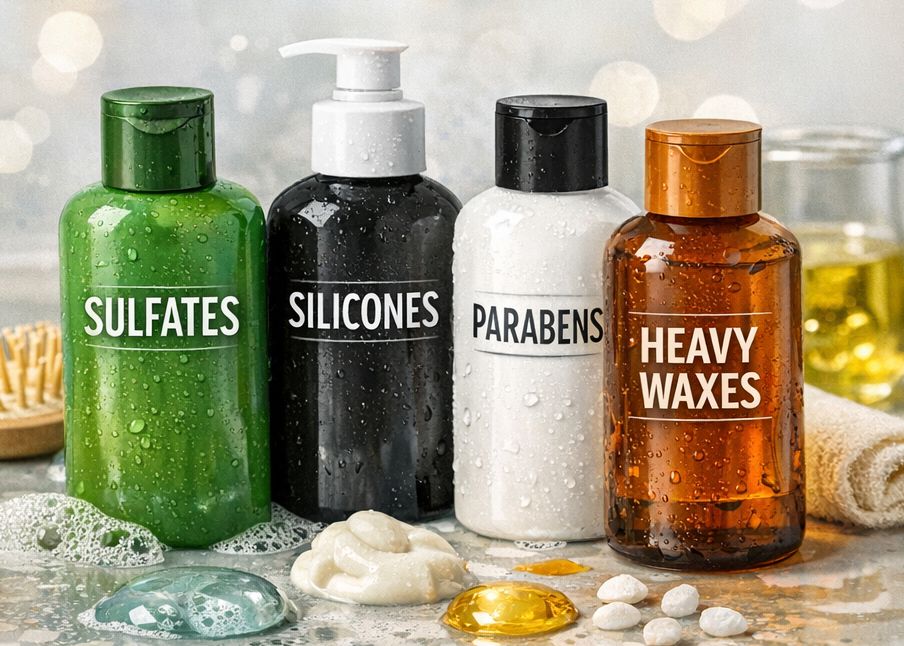
The 5 Volume Killers — And Where They Hide
These are the ingredients most likely to be doing silent damage to your fine hair right now. Check your current bottles while you read.
01
Dimethicone
Also listed as: Amodimethicone, Cyclomethicone, Cyclopentasiloxane, Dimethiconol
Dimethicone is a silicone — a synthetic polymer derived from silicon dioxide — and it’s one of the most commonly used conditioning agents in hair care. It works by wrapping each hair strand in a smooth, slippery coating that reduces frizz and adds shine. On thick or coarse hair, this is genuinely useful. On fine hair, it’s a problem.
The issue is that silicones are hydrophobic: they repel water. That means regular shampoos — even “clarifying” ones — often can’t fully remove them. With each wash, a little more Dimethicone remains. Over weeks, this builds into a cumulative layer that weighs fine strands flat, prevents moisture from penetrating properly, and makes hair feel limp and coated no matter what else you put on it.
Why it’s worse for fine hair: The coating-to-strand-size ratio is much higher on fine hair. What feels like “a light conditioning effect” on thick hair feels like a lead blanket on fine strands.
02
Shea Butter & Heavy Butters
Also listed as: Butyrospermum Parkii, Cocoa Butter (Theobroma Cacao), Mango Butter (Mangifera Indica)
Shea butter is a genuinely wonderful ingredient — for people whose hair it’s designed for. It was developed as a moisturizer for thick, coarse, or tightly-coiled hair that struggles to retain moisture. For those hair types, its heavy emollient properties are deeply nourishing.
For fine hair, it suffocates. Shea butter is extremely dense and occlusive, meaning it creates a barrier on the surface of the hair that locks in moisture — but also locks in weight. Applied to fine strands (especially near the roots), it pulls them flat almost instantly. That “no-frizz, smooth, bouncy” result on the front label is written for a completely different hair type than yours.
Why it’s worse for fine hair: Fine hair has fewer cuticle layers, so it absorbs heavy butters more readily and can’t carry the weight. Even a small amount near the scalp will flatten roots within hours.
03
Mineral Oil & Petrolatum
Also listed as: Paraffinum Liquidum, Petrolatum, White Petrolatum, Cera Microcristallina
Mineral oil and petrolatum are petroleum-derived occlusive agents. They’re cheap, stable, and shelf-life extending — which is why manufacturers love them. They work by coating the hair in a thin petroleum film that seals moisture in and adds slip.
The problem for fine hair is twofold. First, they’re extremely resistant to water — meaning they accumulate over washes instead of rinsing clean. Second, they attract dust and environmental particles, which adds further weight and makes hair look dirtier faster than it actually is. If you’ve noticed your hair going flat and dull after just one day, this family of ingredients is a likely suspect.
Why it’s worse for fine hair: Accumulation is the keyword. One application is manageable. But after two weeks of daily use, the residue is substantial enough to make fine hair feel permanently coated and limp.
04
Heavy Waxes
Also listed as: Beeswax (Cera Alba), Carnauba Wax (Copernicia Cerifera), Candelilla Wax, Microcrystalline Wax
Waxes are used in stylers, pomades, and some conditioning treatments to add definition, hold, and texture. They work great for creating structured styles on thick hair. On fine hair — especially when used near the roots or in leave-in products — they create immediate, visible heaviness.
The worst part about waxes is that they’re notoriously difficult to remove. Unlike most conditioners that rinse out with warm water, waxes often require multiple shampoo passes or a clarifying wash to fully clear. This means that “try it once” quickly becomes “it’s been in your hair for a week.”
Why it’s worse for fine hair: Fine strands can’t handle the structural weight that waxes add. What creates “texture and definition” on thick hair creates a clumped, stringy look on fine hair.
05
Heavy Polyquaterniums (High Concentration)
Also listed as: Polyquaternium-10, Polyquaternium-11, Polyquaternium-37, Guar Hydroxypropyltrimonium Chloride
Polyquaterniums are conditioning polymers that give hair that “silky, smooth, detangled” feeling. In small amounts and rinse-out products, they’re largely harmless. The problem arises when they appear high on the ingredient list — especially in leave-in conditioners, detanglers, or styling products.
In higher concentrations, polyquaterniums build up on the hair shaft similarly to silicones. They attract and hold moisture from the air, which sounds helpful until you realize that on fine hair in any amount of humidity, this translates directly to limpness and frizz that no product can fix from the outside.
Why it’s worse for fine hair: The polymer-to-strand coating ratio. A concentration that’s gentle conditioning on thick hair becomes a noticeable weight blanket on fine strands, especially with repeated use.
How to Read Any Label in 10 Seconds
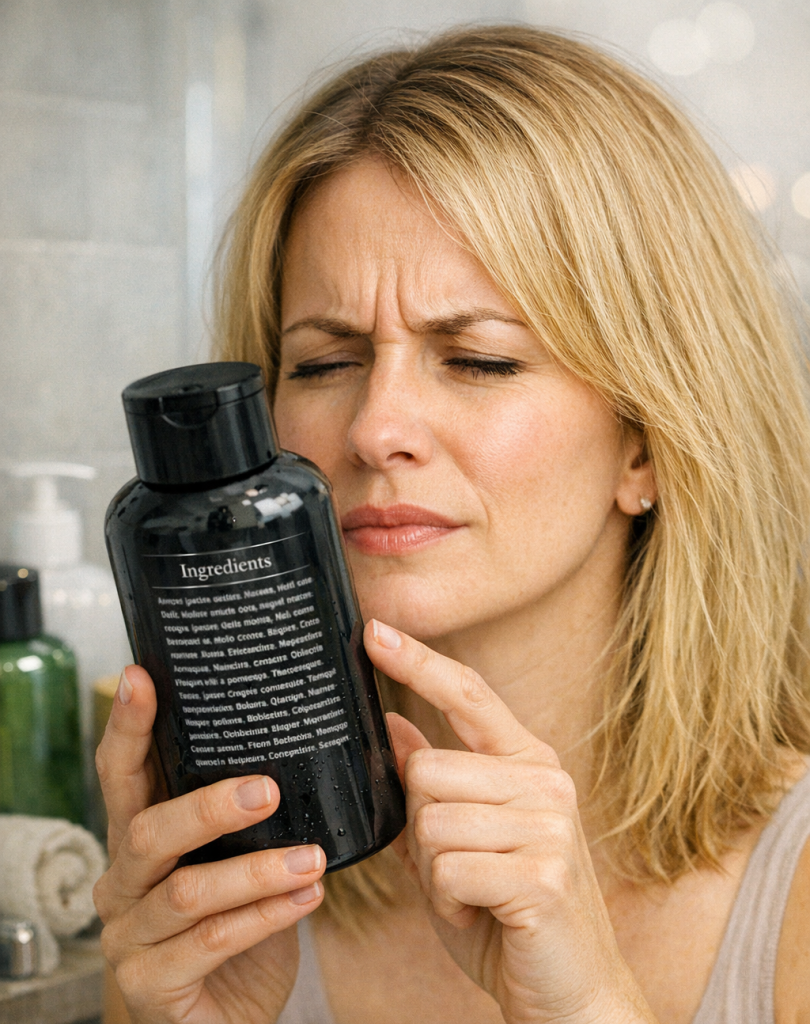
You don’t need a chemistry degree. You need one rule.
🔍
The First-Five Rule
Cosmetic ingredients are listed in descending order of concentration — highest amount first. Check only the first 5 ingredients on any bottle. If a Volume Killer appears there, that ingredient makes up a significant portion of the product and will affect your hair meaningfully. An ingredient buried at position 18 is present in trace amounts and probably won’t matter. An ingredient at position 2 is a major component of what you’re putting on your hair every day.
The next time you pick up a bottle — at the drugstore, at the salon, even for something you’ve been using for years — flip it over and read positions 1 through 5. That’s your entire audit. It takes ten seconds and tells you more than the front label ever will.
Your 2-Minute Cabinet Audit
Walk into your bathroom right now — or after you finish reading. Pick up your shampoo, your conditioner, your leave-in, and any stylers. Check the first five ingredients on each one against this checklist:
- Does your shampoo contain Dimethicone, Amodimethicone, or Cyclopentasiloxane in the first 5 ingredients? → Volume Killer.
- Does your conditioner or mask contain Shea Butter (Butyrospermum Parkii), Cocoa Butter, or Mango Butter in the first 5? → Volume Killer.
- Does any product contain Mineral Oil (Paraffinum Liquidum), Petrolatum, or any Wax near the top of the list? → Volume Killer.
- Does your leave-in or styler have Polyquaternium-10 or Polyquaternium-37 listed in the first 5? → Possible buildup risk.
- Tally up your results. 0 killers = you’re already ahead. 1–2 = easy targeted swap. 3+ = your cabinet is the primary reason your hair won’t hold volume.
Most people with chronically flat fine hair find at least two Volume Killers in their current rotation. Some find them in every single product they own.
Want this as a printable? We put the full blacklist, label rule, and checklist on one page that you can stick on your bathroom mirror.
✨ FREE FINE HAIR AUDIT
Struggling with flat, lifeless roots?
Download your Fine Hair Audit and uncover the top mistakes that keep fine hair from holding volume — plus what to fix first.
What to Look for Instead
Identifying the problem is step one. Here’s what actually works for fine hair — ingredients that add body and manageability without the cumulative weight:
Fine-Hair Approved Ingredients
- Hydrolyzed Wheat Protein / Hydrolyzed Silk — Adds lightweight body and strand-strengthening without any coating effect—one of the best fine-hair ingredients available. The Hair Lab Heat Defense Dose Set with Hydrolyzed Wheat Protein is a great, affordable option for only $6.43.
- Panthenol (Vitamin B5) — Penetrates the hair shaft to plump it gently from within. Adds volume without sitting on the surface. Pantene Pro-V Daily Shampoo, Curl Perfection with Pro-Vitamin B5 offers this for $9.97
- Glycerin — A light humectant that draws moisture into the shaft without heaviness. Fine in all climates when balanced with other ingredients. CLn 2-in-1 Gentle Wash & Shampoo doubles as a body wash and is one of the highest-rated Glycerin products. Get it for $36.
- Aloe Vera Juice (high on the list) — Lightweight, hydrating, and non-coating. One of the finest hair-friendly conditioners on the market.
- Niacinamide — Scalp-focused ingredient that improves follicle health and reduces inflammation. Helps address the root cause of the volume problem.
The Short Version
Fine hair is not a problem you were born with — it’s a problem that’s often created and sustained by the wrong product ingredients. Dimethicone, Shea Butter, Mineral Oil, Heavy Waxes, and high-concentration Polyquaterniums all create an invisible coating or weight on fine strands that builds up over time and resists washing.
The fix starts with a ten-second label check. Look at the first five ingredients in your current products. If a Volume Killer is there, that’s where your flat hair is coming from — and that’s where the solution starts too.
You now know more about your own shampoo bottle than most people ever will. Use it.
Medical Disclaimer: This article is for general educational purposes only and isn’t a substitute for professional hair or medical advice. Always follow the guidance of your stylist or healthcare provider for your specific needs.